In the session, you know what you’re doing. The problem is all the paperwork around it.
Even a practice of one needs a privacy officer under the Privacy Act. Since 1 May 2026, when you collect a client’s health information from someone else, such as their GP, a parent or a school, the Health Information Privacy Code expects you to let them know. And health records have to be kept for at least 10 years from the day after you last provided services.
✕
You use the same consent form for an adult, a couple and a child, copied from a colleague years ago.
✕
You explain the limits of confidentiality from memory, in the first session, in front of the client.
The 2026 Psychology Practice Folder · New Zealand edition
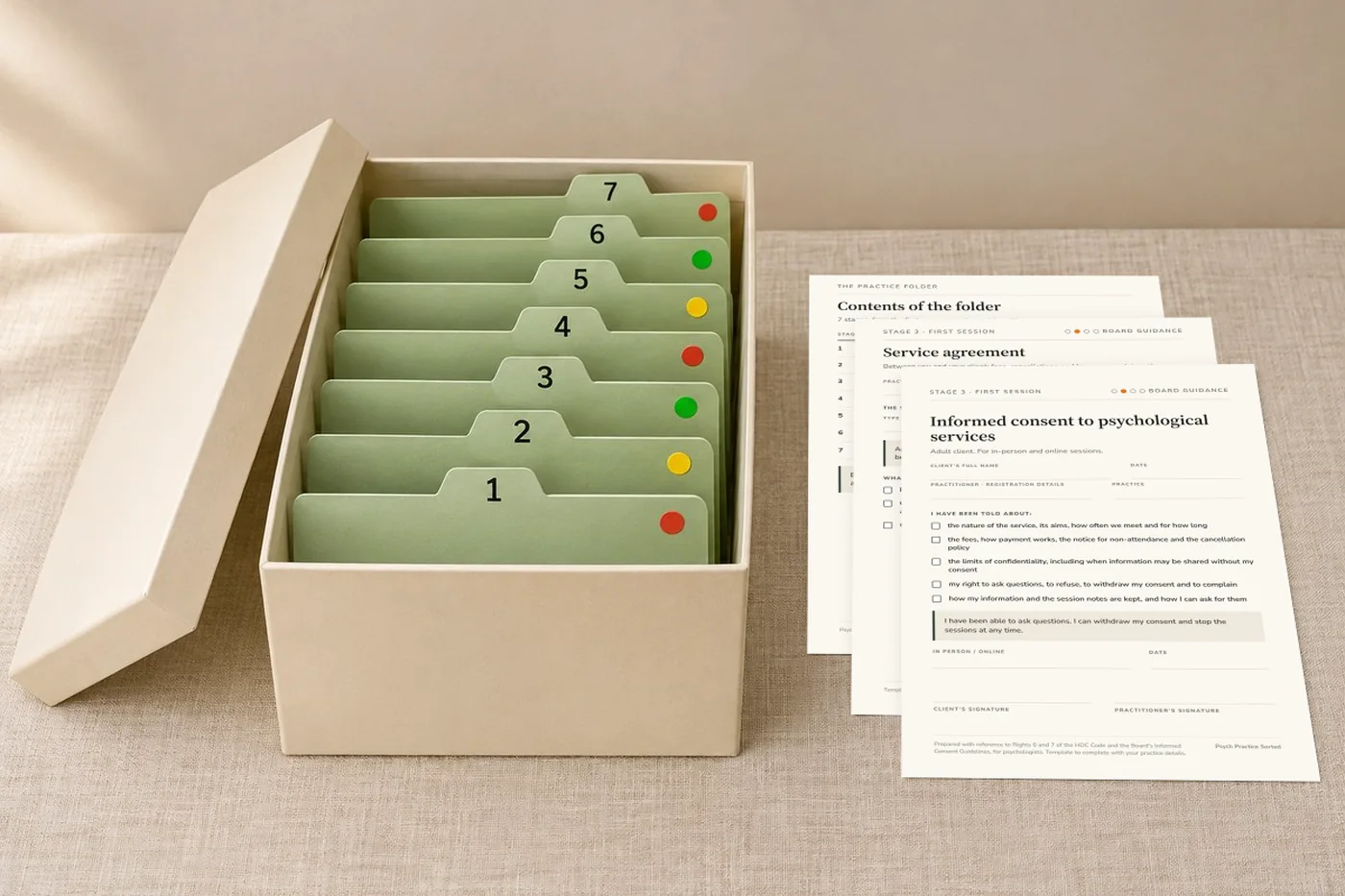
A consent form copied from a colleague was written for their practice, not yours. Here your documents come in the order you use them with each client, from the first message to the archive.
Written for practice in Aotearoa New Zealand: the Code of Health and Disability Services Consumers’ Rights, the Privacy Act 2020 and the Health Information Privacy Code 2020 (as amended on 1 May 2026), the Health (Retention of Health Information) Regulations 1996, and, for psychologists, the Code of Ethics for Psychologists Working in Aotearoa New Zealand and the Board’s best practice guidelines. Each template states its reference at the foot of the page: law, Board guidance or good practice. A client can ask for their file any day.
Every template in Psych Practice Sorted carries a coloured dot that tells you what it rests on. Answer the 7 questions, one for each stage of the folder.
Required: law, the HDC Code or the Health Information Privacy CodeBoard guidance (psychologists)If it applies to youProtects you
01
The practiceAre your fees and your non-attendance notice written down, and do clients get them before they consent?
02
First contactDoes every client get a privacy notice when you first collect their details, and a Rule 3A notice when you receive their information from someone else?
03
First sessionFor every client, is there a signed consent form and a service agreement you could show?
04
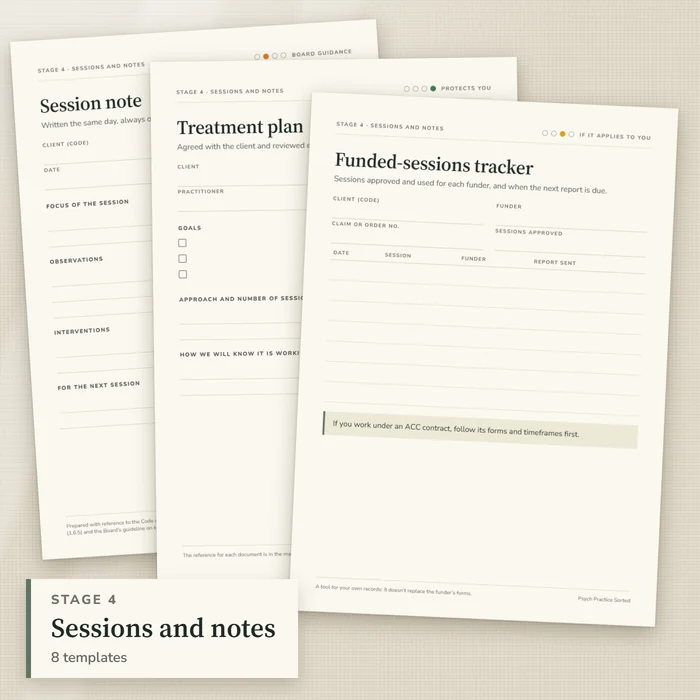
SessionsDo you write every session note on the same template?
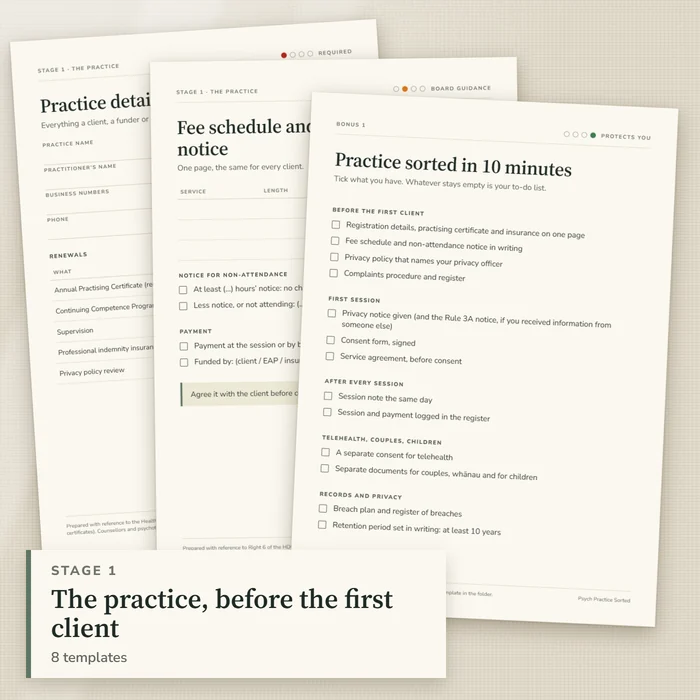
The practice, before the first client · 8 templates
Solves“I’m not sure what I should have ready before the first client.”
Letterhead and practice details sheet with your registration details, and a practice register for your Annual Practising Certificate (renew by 31 March), Continuing Competence Programme, supervision and indemnity insurance
Fee schedule and non-attendance notice, agreed with the client before consent and recorded in writing, as the Board’s Informed Consent Guidelines expect (the HDC Code gives clients the right to know the costs before they decide)
Complaints procedure, register and acknowledgement letter (the HDC Code expects a written acknowledgement within 5 working days), and an invoice and receipt with fields for your business details
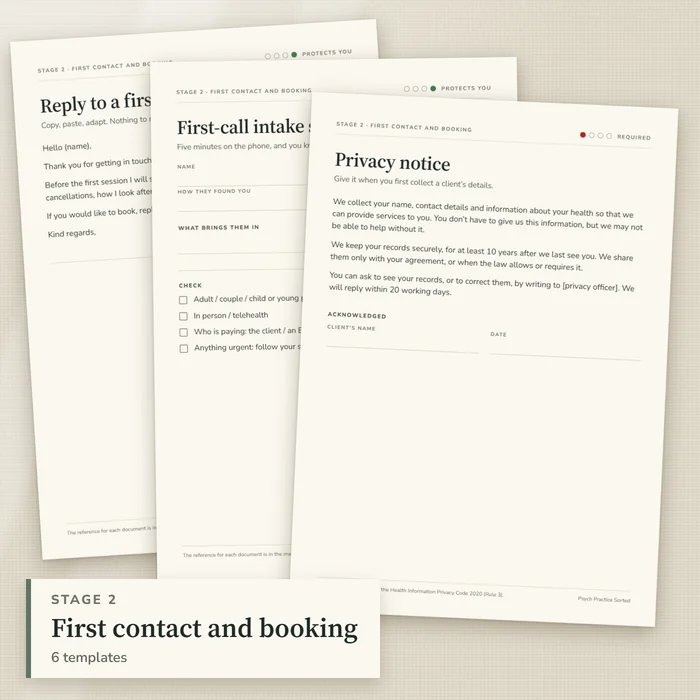
Solves“Every new enquiry, I write the reply from scratch.”
Reply to a first enquiry, first-call intake sheet, appointment confirmation and reminder
Funder checklist for ACC, EAP or private clients: who is paying, the claim or order number, the sessions authorised and the date of the next report (if you work under an ACC contract, its own forms and timeframes come first)
Privacy notice to give when you first collect a client’s details (Health Information Privacy Code, Rule 3), the Rule 3A notice for information you receive from someone else, such as a GP, a parent or a school (since 1 May 2026), and consent to contact by text, email or messaging apps
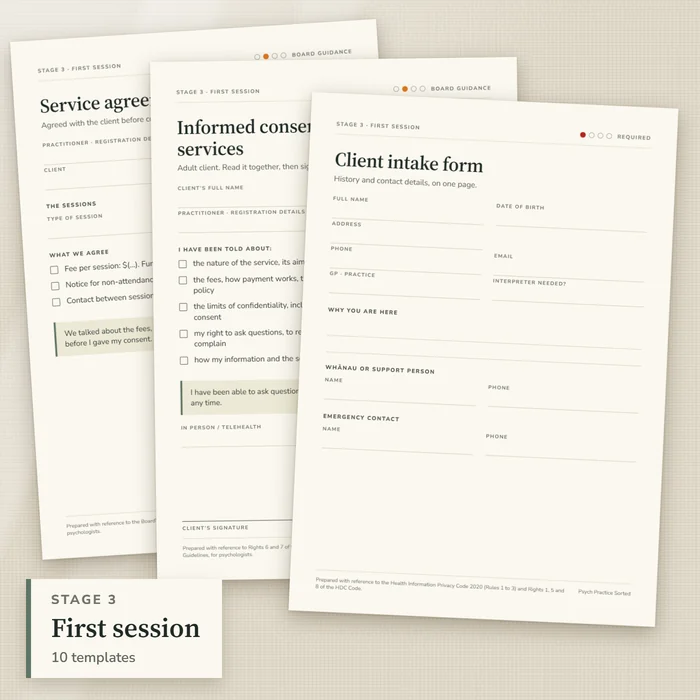
Solves“I improvise the consent in front of the client.”
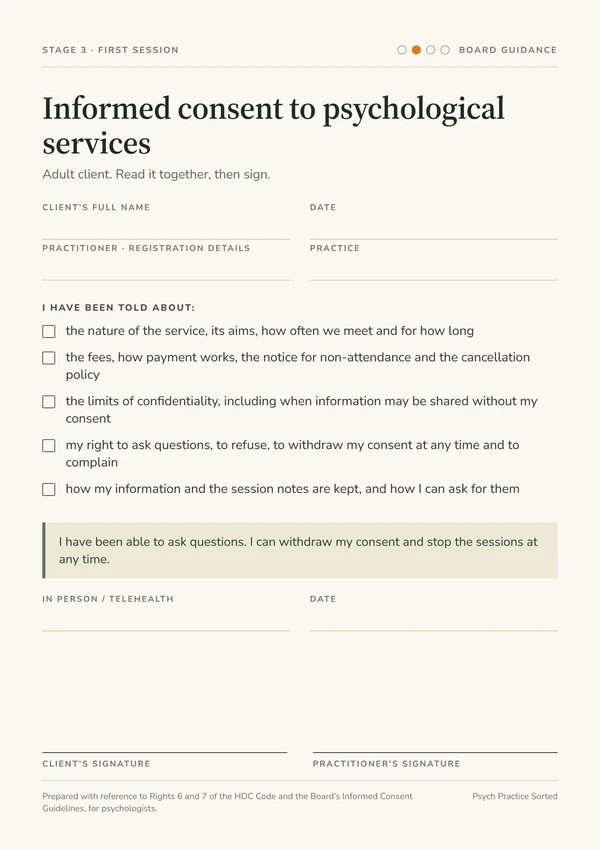
Informed consent to psychological services: your role, the limits of confidentiality, the fees, the right to refuse or withdraw, and how to complain (HDC Code, Rights 6 and 7). The Board’s Informed Consent Guidelines expect consent to be documented, and a written consent form is appropriate in most circumstances
Intake form with fields for whānau or a support person and an interpreter, assessment consent, a service agreement, consent to record a session (the Board’s guidelines call for explicit written consent first), and AI tools consent and opt-out
The limits of confidentiality in plain words (you may report concerns about a child to Oranga Tamariki or the Police), and consent to share information with the client’s GP
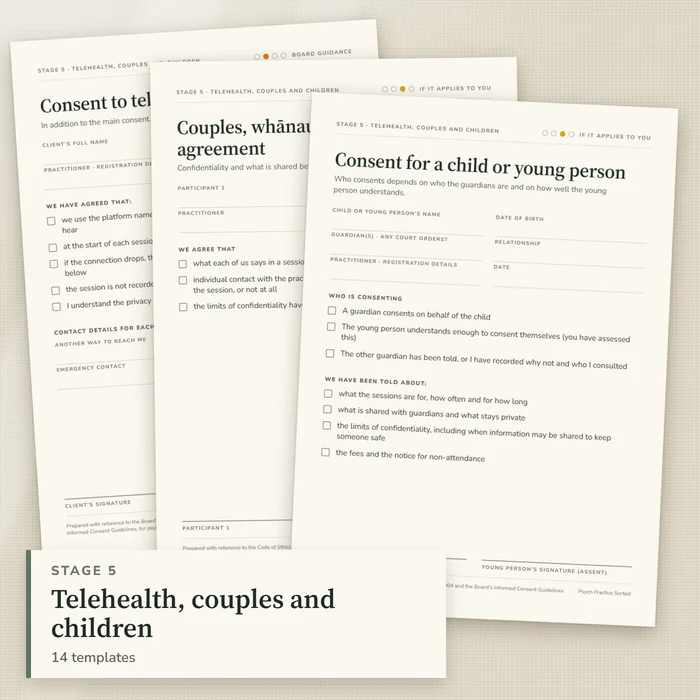
Solves“I have the same form for an adult, a couple, a child and telehealth.”
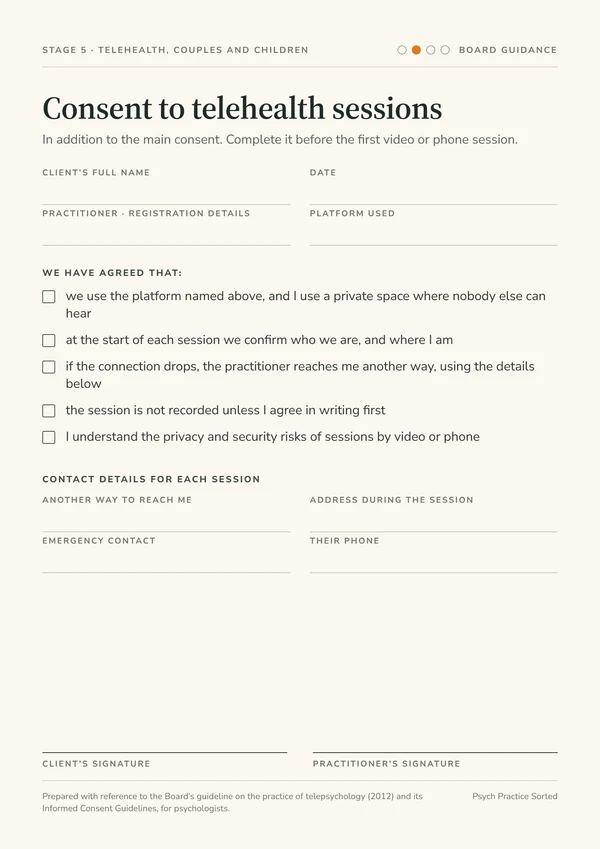
Telehealth: consent and session safety plan (privacy and security risks, another way to reach the client if the connection drops, emergency contact and local resources, recording only with explicit written consent)
Couples, whānau and groups: why the format suits everyone, what is shared between participants, and consent free from pressure
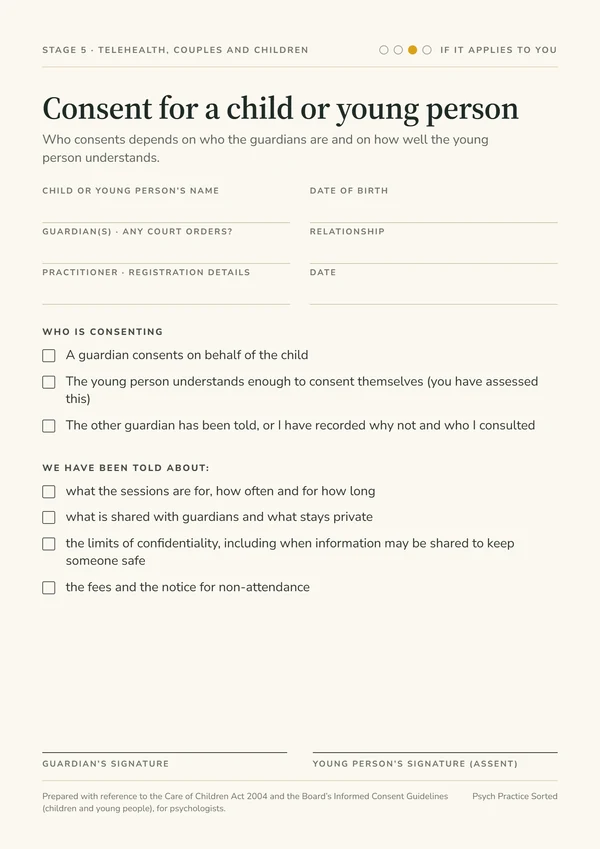
Children and young people: a guardian’s consent, the young person’s own consent and assent, a letter to the other guardian, a record of your attempts to reach them, and written consent from all guardians when the Family Court is involved (the Board’s Informed Consent Guidelines)
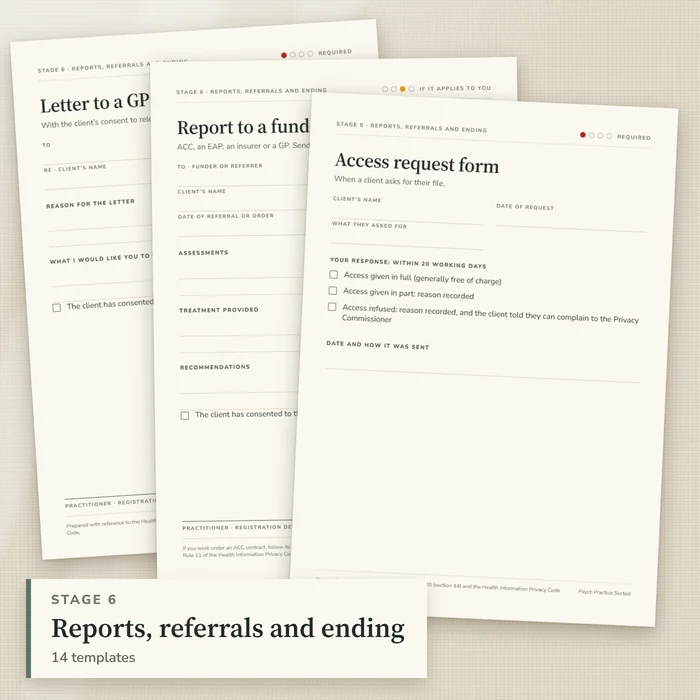
Report and letter header with your registration details, recipient and subject; consent to release information (Health Information Privacy Code, Rule 11), referral letter and letter to a GP
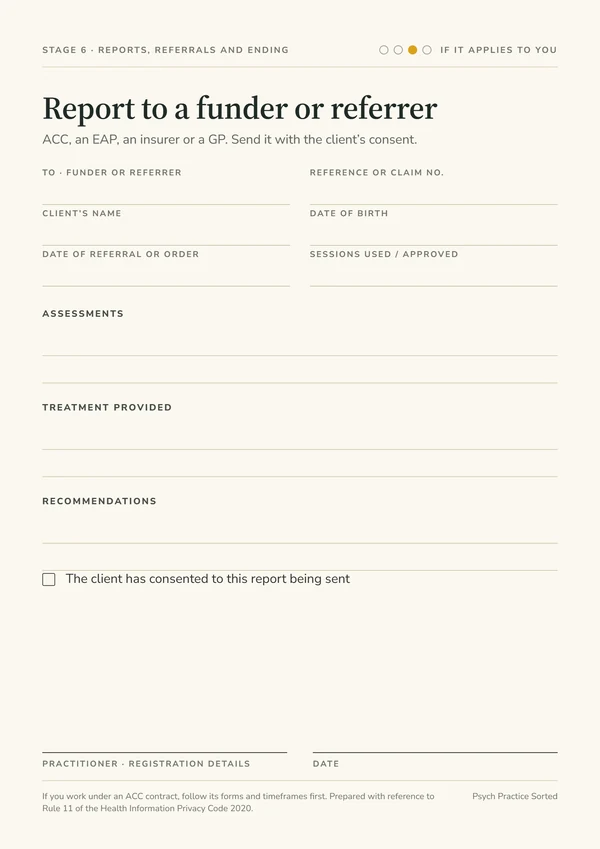
Report to a funder or referrer, factual attendance letter, termination letter, practice closure letter and a professional will (the Code of Ethics asks you to plan for access to your records if you fall seriously ill or die)
Access request form and your response letter (within 20 working days, generally free of charge), correction request and statement of correction, and transfer of records to another provider
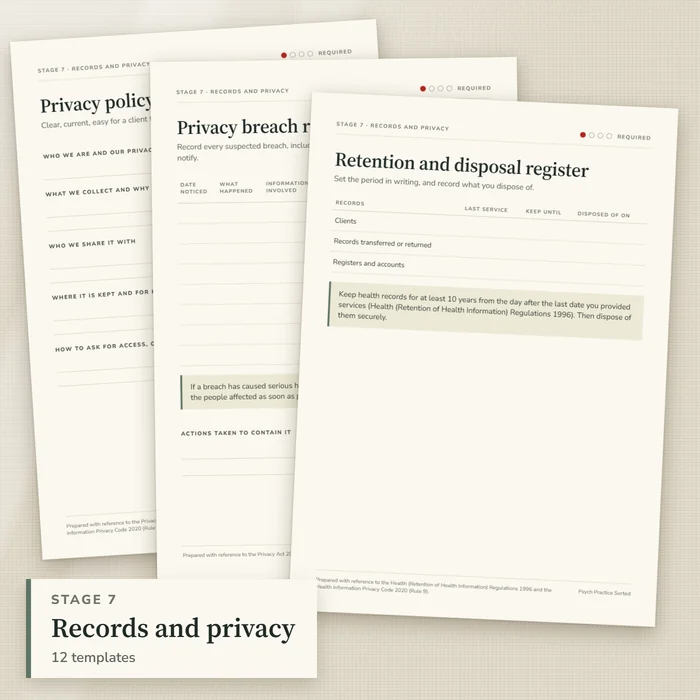
Solves“I’m not sure my clients’ information is handled properly.”
Privacy policy that names your privacy officer (the Privacy Act requires every agency to have one, even a practice of one)
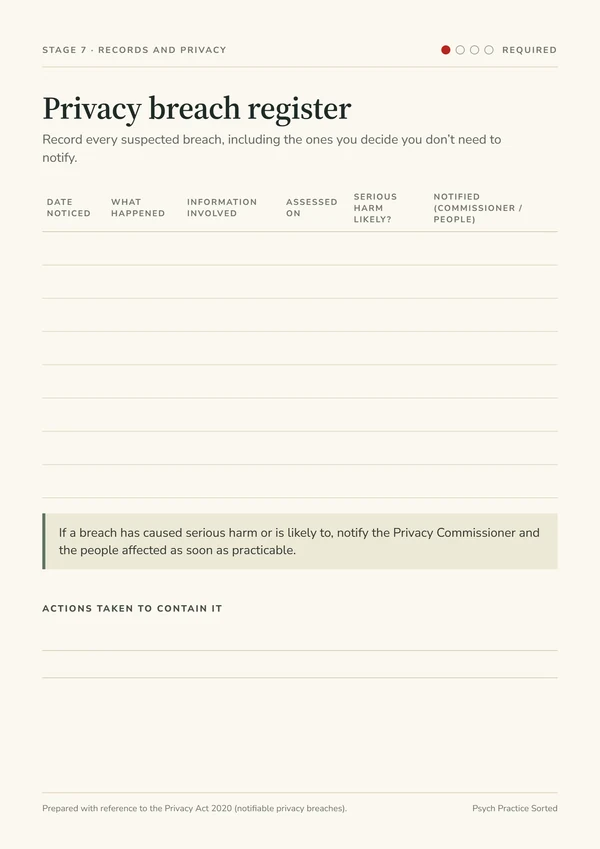
Privacy breach plan, assessment checklist, register and notification letters (a breach that could cause serious harm must be notified to the Privacy Commissioner as soon as practicable), and a security checklist for your software, cloud and telehealth providers
Retention and disposal register: keep health records for at least 10 years from the day after you last provided services (Health (Retention of Health Information) Regulations 1996), then dispose of them securely, and a continuity-of-care plan
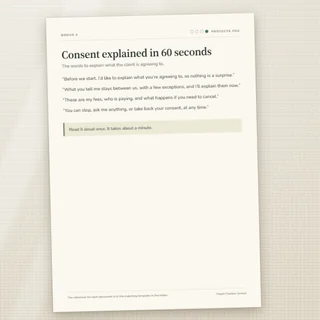
The words to explain what the client is agreeing to, including fees and who is paying, without sounding like admin.
✓ INCLUDED
BONUS 5 · INCLUDED
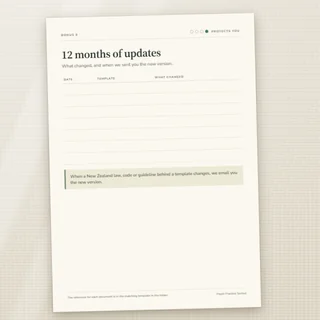
12 months of updates
“What if the rules change?”
When a New Zealand law, code or guideline behind a template changes, we email you the new version. The Board is working on a new Code of Conduct: when it’s published, we email you the updated templates.
✓ INCLUDED
All 5 bonuses come with the folder, in the same NZ$39 order
30-day money-back guaranteeIf the folder isn’t right for your practice, email us within 30 days of purchase and we’ll refund you in full. This is in addition to any rights you have under New Zealand law, including the Consumer Guarantees Act 1993 where it applies. These are editable templates you adapt to your own practice. They are not legal or clinical advice and do not replace advice from your professional body, your supervisor, your indemnity insurer or a lawyer.
Fast deliveryStraight after payment you receive the welcome guide with the checklist by email. The 72 templates, the 7 dividers and the 5 bonuses arrive at the same address within 48 hours.
Secure payment
One-off payment
30-day guarantee
By email
★★★★★ 4.9 out of 5
What colleagues who use it already say
Practitioners across New Zealand who sorted their paperwork.
★★★★★Emma R. · registered psychologist in private practice · Auckland
“I’d been using a colleague’s consent form for years. Now I have one for adults, one for couples and one for teenagers, and I don’t improvise in front of the client any more. I put my details on everything in one afternoon.”
★★★★★Daniel K. · clinical psychologist in a group practice · Wellington
“My letters never had a subject line or my registration number. With the folder’s header, my details, the recipient and the subject are always there: I only write what the letter is about.”
★★★★★Priya S. · counselling psychologist · Christchurch
“The checklist showed me straight away that I had no breach plan and no register. A week later, both were done, and my privacy policy finally names me as the privacy officer.”
★★★★★Chloe T. · counsellor (NZAC), new in private practice · Hamilton
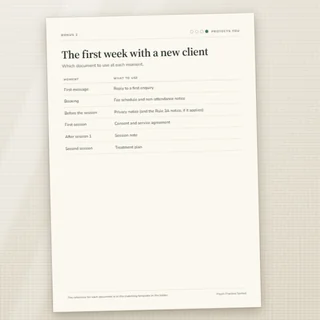
“I’d just started out and didn’t know what to use when. The bonus ‘The first week with a new client’ showed me which document to send at the first message, in the first session and after it. For NZ$39 I didn’t expect this much.”
★★★★★Mitchell J. · educational psychologist · Tauranga
“A mum came in alone with her 10-year-old. I had the consent with the fields for who the guardians are and who signs, the letter for the other guardian and the page to record my attempts to reach him. Nothing to look for.”
★★★★★Jess W. · psychotherapist · Dunedin
“A former client asked for a copy of her file. I had the access request form, the response letter and the 20-working-day date on the register. It was sorted without losing my evening.”
you only work in a hospital, clinic or organisation that has its own forms;
you’re looking for therapy protocols or worksheets for your clients: these are the documents of the practice;
you want practice-management software: this is a folder of documents, not an app.
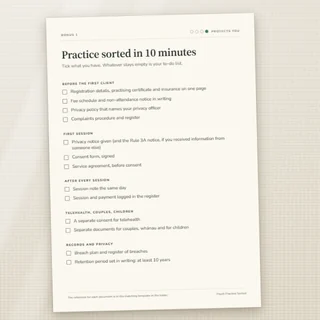
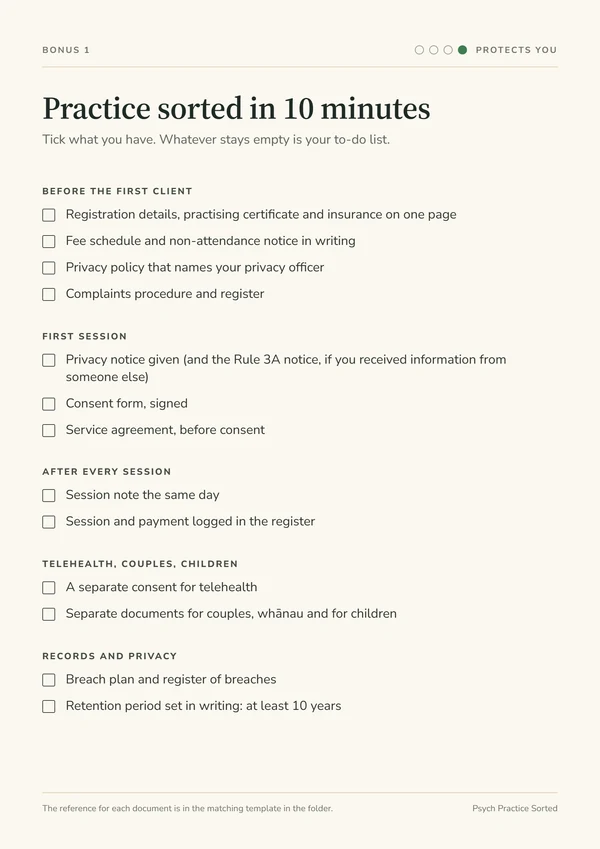
Straight after payment you receive the welcome guide by email, with your order details and the checklist ‘Practice sorted in 10 minutes’. The 72 templates, the 7 dividers and the 5 bonuses arrive at the same address within 48 hours, in Word and PDF. If you can’t see the email, check your spam and promotions folders too.
Yes. They are ready-to-edit templates written for psychologists, counsellors and psychotherapists in private practice in Aotearoa New Zealand, prepared with reference to the framework in force in November 2026: the Code of Health and Disability Services Consumers’ Rights, the Privacy Act 2020 and the Health Information Privacy Code 2020 (as amended on 1 May 2026), the Health (Retention of Health Information) Regulations 1996, the Care of Children Act 2004 and, for psychologists, the Code of Ethics for Psychologists Working in Aotearoa New Zealand and the Board’s best practice guidelines. Each template states its reference at the foot of the page, and says whether it is law, Board guidance or good practice. These are editable templates you adapt to your own practice. They are not legal or clinical advice and do not replace advice from your professional body, your supervisor, your indemnity insurer or a lawyer. Psych Practice Sorted is an independent publisher. It is not affiliated with, approved or endorsed by the New Zealand Psychologists Board, the Health and Disability Commissioner, the Privacy Commissioner or any regulator.
Not in itself. The Code of Ethics for Psychologists Working in Aotearoa New Zealand and the Board’s best practice guidelines are the Board’s standards for psychologists: the Board, the Health Practitioners Disciplinary Tribunal and the courts use them as a guide to proper practice. The HDC Code, the Privacy Act 2020, the Health Information Privacy Code and the retention regulations are law. The folder tells you which is which at the foot of every template, with the coloured dot at the top.
The HDC Code requires informed consent, and asks for it in writing only in particular cases, such as research. The Board’s Informed Consent Guidelines expect consent to be documented, and a written consent form is appropriate in most circumstances. The folder gives you a consent form for therapy, a separate consent for assessments and a service agreement, so you have a written record of what the client was told.
Yes for the HDC Code, privacy, records and funder documents. Where a template cites the Psychologists Board’s Code of Ethics or guidelines, check it against your own code (the NZAC Code of Ethics or the Psychotherapists Board’s standards).
The folder helps you organise your practice documents. It does not register you with the Board, it does not change your scope of practice, and it is not a guide to running a telehealth-only practice. If you’re still under supervision, check each document with your supervisor before you use it.
Yes. The bonus ‘The first week with a new client’ shows you which document to use at each moment, and the checklist what to have ready before your first client. The letterhead has fields for your registration details and practice details.
The Board’s Informed Consent Guidelines say that for a young person the question is how well they understand, not only their age, and that it is normally good practice to involve all the guardians and, if you can’t, to record why. The folder includes a guardian’s consent, the young person’s own consent and assent, a letter to the other guardian and a page to record your attempts to reach them. Where the Family Court is involved, the Board’s guidelines say to get written consent from all guardians first. Check any court orders before you start.
The folder has a funder checklist (who is paying, the claim or order number, the sessions authorised and the date of the next report), a funded-sessions tracker and a template for a report to a funder or referrer. If you work under an ACC contract, follow its forms and timeframes first: the folder is not linked to ACC, an EAP or any insurer, and it doesn’t replace their own forms.
The folder has a service agreement and a fee schedule with a non-attendance notice that the client reads before consenting. The Board’s Informed Consent Guidelines say the notice that applies to non-attendance should be discussed with the client before consent and recorded in writing. Whether and how much you charge for a missed session is your decision. If you work under an ACC contract, check what it allows. If in doubt, check with your professional body or your indemnity insurer.
Yes. Each has its own document, and the dot at the top tells you what it rests on. The telehealth consent covers the security of the platform, the risks to privacy, recordings, another way to reach the client if the connection drops and an emergency plan.
Word (it also opens in Google Docs and Pages) and print-ready PDF. No software to learn.
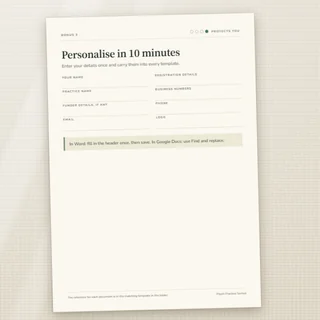
Yes. You enter your name, registration details, practice details and logo once and carry them into every template. The bonus ‘Personalise in 10 minutes’ shows you how.
10 minutes for the checklist. Then 15 minutes a day for 7 days, one stage at a time.
A copied consent form was written for someone else’s practice, and often for another country. Here you have the documents in the order you use them with a client, sorted by situation, with your letterhead and a dot that shows you what each one rests on.
The Board is working on a new Code of Conduct; when it’s published, we email you the updated templates. In general, if within 12 months of purchase a New Zealand law, code or guideline behind a template changes, we email you the new version.
No. You pay NZ$39 once, and the documents are yours, with updates for 12 months.
You have 30 days: one email to thehoord@gmail.com is enough and we refund you in full. The templates stay yours. This is in addition to any rights you have under New Zealand law, including the Consumer Guarantees Act 1993 where it applies.
Privacy. The entity responsible for your personal information is The Foorge (NRT F-421429-V), Carrer de l’Estadi 18, 1-1, AD500 Andorra la Vella, Andorra, thehoord@gmail.com, which is also our privacy officer’s contact. We handle your name, email address and order details to deliver your order, meet our accounting obligations and keep the shop secure, in line with the Privacy Act 2020. We share them with Impultienda, Stripe, Moonshot Marketing Agency LLC, our hosting and email providers and Meta Platforms (ad measurement). During your visit the page loads the Meta pixel (cookie _fbp) to measure our ads; you can block cookies in your browser. We do not store card details. You can ask for access to your information, its correction or deletion by emailing thehoord@gmail.com: we reply within 20 working days. You can complain to the Office of the Privacy Commissioner if you are not satisfied with our response.
Terms. Digital product, one-off payment of NZ$39, no subscription. The welcome guide is emailed straight after payment; the 72 templates, the 7 dividers and the 5 bonuses within 48 hours. These are editable templates you adapt to your own practice. They are not legal or clinical advice and do not replace advice from your professional body, your supervisor, your indemnity insurer or a lawyer. Updates included for 12 months from purchase. Sold by Moonshot Marketing Agency LLC, trading as The Hoord.
Refunds. 30-day money-back guarantee: if the folder isn’t right for your practice, email thehoord@gmail.com from the address you used to order, within 30 days of purchase, and we’ll refund you in full. This is in addition to any rights you have under New Zealand law, including the Consumer Guarantees Act 1993 where it applies. If the folder hasn’t reached you, email us and we resend it or, if you prefer, refund you.